Tuesday, 8 September 2020

Annette Tembo: A Challenge for Women

“Until EVERY young girl can see themselves represented in government, the work is not done.” EMILY's List.

By ANN ZULU and BESA MULAYE
In Zambia, like many African countries, it is believed that men are connected with ‘hard’ politics and women with ‘soft’ politics at home. This invariably leaves women out when it comes to making important decisions about how the country should be run, but also at a more personal level on issues that affect women such as reproductive health.

Think about it, do you really want a group of men deciding on your reproductive and sexual health? This toxic mentality that women only have a say at home has led to the continued under-representation of women in decision making positions over the years. Even decisions that directly affect women.
Currently, there are only 28 women out of 165 Members of Parliament (MP) in Zambia, yet women make up 51 percent of the Zambian population. The fact that decisions are made for women and that they are actively or passively left out is unacceptable.
Why is it a radical idea to have all female MPs in the Zambian parliament? It is after all normal to have an all-male parliament. Why is it a radical idea to have 50% female representation in parliament? Are we truly a democracy when, to borrow from author Agnes Ngoma Leslie, ‘public participation in the political and democratic process’ is only reserved for some?
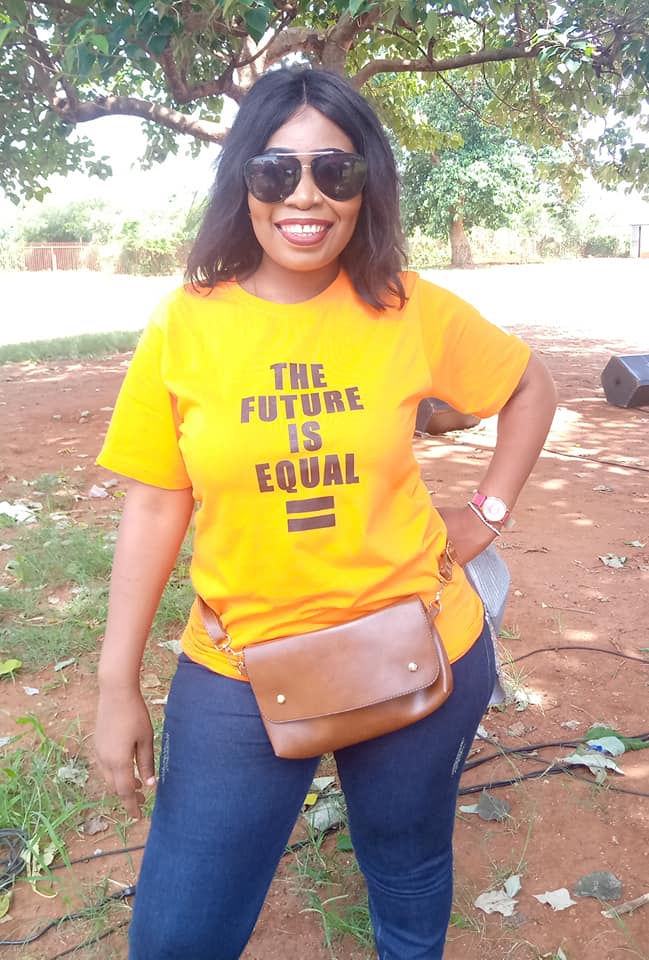
Annette Hamiatu Tembo, is an aspiring Zambian female politician. She has guts and intends to change this political narrative. She is ready to take on her male counterparts come the 2021 General Elections. Inspired by South African anti-apartheid activist and politician Winnie Mandela, Annette began her political career in 2017. She wants to be a Member of Parliament (MP) and will work with people at a grassroots level to improve their lives.
Annette Tembo


“I grew up in the ghetto, Lusaka´s Chibolya Compound, so seeing the high rate of poverty that I was surrounded with, how alcohol and drugs were being abused by women and youth, and also the high levels of Gender Based Violence, has given me a push to want to serve my community,” says Annette. She adds that her Muslim religion has also contributed to her desire to serve people, as she has been serving in the mosque since her childhood.
Asked how her family has taken her political ventures especially considering that her family has observed a traditional interpretation of Islamic law that places serious restrictions on women, Annette said it was a challenge at first because of the hostility that comes with politics. But finally, they accepted it as her passion and started to support her.
“My family understands my desire to bring positive change in people’s lives. Although my mom sometimes gets scared and I understand it is normal. Being Islam as a woman does not stop me from aspiring for political office,” she said.
Annette feels that the challenges that women and girls continue to face, such as the unfair distribution of resources and discriminatory laws among others, can only be addressed if women have equal representation in decision making positions. Annette urges women to stop shunning politics for fear of being harassed, but rather stand up for their rights and demand positive change.
Are we not after all full citizens who should equally be involved in the development of our country?
“Yes, the political situation in Zambia can be violent and there are so many discriminatory remarks against women. We have heard discriminatory remarks against female politicians such as Dorah Siliya, Nkandu Luo, Mumbi Phiri and Edith Nawakwi, but for how long are we going to live in fear? Enough is enough, it is time we stood up and made a change,” implored Annette.
In this writer's opinion: our personal feelings about specific female politicians aside, can we all agree that they do not get criticised as their male counterparts do? Do male politicians typically get critiqued for how they dress? Do sexist judgments such as ‘she should be at home taking care of her family’ ever get thrown at male politicians? What would Zambia look like, if the brave women who venture into politics were engaged and criticised on the substance of their politics, the proposals and the positions they support, rather than what they wear, or the threadbare 'she should be home, taking care of her family'. Male politicians are not criticised in this way! Let us commit to engage our female politicians on matters of substance, as we do for our male politicians. Take a moment and imagine what Zambia would be like if parliament had 165 female MPs.
Leslie’s research asserts that Female MPs face challenges on many levels including financial (fundraising and campaigning), social, and cultural. That means even after they do beat the odds and actually get elected, they still face challenges. Leslie reminds us that Hon. Professor Nkandu Luo was once asked to leave parliament because of the way she was dressed. In fact, Leslie reports, Hon. Professor Nkandu Luo has shared that her high level of education often works against her.
The list of reasons why we should all consider running for public office is probably endless. For example, you probably do not want an all-male panel deciding on issues related to your care if you are ever pregnant. To this end Annette has a challenge for us all:
“I am challenging my fellow young women to start participating in politics, we need to fight for ourselves and for our children. If we don’t, then who will fight for us? For how long have these male counterparts been MPs and has anything changed? Have our rights improved? The answer is no, we need to get up and fight."


Special credit to TZTF

Thursday, 13 August 2020

Check your brand of feminism

 ANN ZULU Writes


As much as we urge women to make money and be financially independent, do not make it a criterion for gender equality.

Saying "make money so men will consider you equal" is untrue, sexist, unrealistic and elitist.


Untrue because even women that are multimillionaires are still disrespected and considered inferior by men. We see it happen everyday where rich and educated women are considered useless just because they are women. Money does not automatically confer you equality as a woman.

Sexist because men are respected and considered superior whether rich or poor. We do not say a poor man is inferior to a woman.

Unrealistic because there will always be poor people (both men and women) in this world. Not everyone will be rich. Not every woman will be a millionaire. Does that mean they do not deserve equality?

Elitist because it makes feminism and the struggle for equality a preserve of rich women. Feminism is for every woman. The pepper seller and the doctor. The CEO and the housewife. Therefore, basing your feminism on financial capacity is useless.

Let me put it this way, African Americans suffer racial prejudice and discrimination in America.

It is insensitive to tell them "go and make money so white people will consider you equal" when they complain of racism.

It is untrue because rich black folks also experience racism. Also, not all black folks will be rich and those poor black people deserve equality and humanity.

Money grants women a certain level of security in the society, no doubt. Which is why we urge women to make money. But money or financial status should not be a criterion for gender equality.

Money should be a tool for female empowerment not a determinant for female empowerment.

Check your brand of feminism. If it thrives on broke-shaming women and telling them your face cream can feed their family, you, my dear woman, are despicable.

Friday, 5 June 2020

Zambian women at AFWID


By ANN ZULU in Johannesburg, South Africa


THE air was on Sunday filled with excitement at the OR Tambo International Airport as women across the African continent flocked in to attend the ongoing African Women in Dialogue (AFWID) conference in Johannesburg, South Africa.

A delegation of 16 participants from Zambia which included women from sectors such as the Social Welfare, Law, Education, Media, Politics and Business among others touched down in johannesberg at exactly 15: 15 hours on November 3, 2019.

Among the noticable faces on the Zambian deligation team are Gender Activist and Former NGOCC Chairperson Sarah Longwe and Women and  Law in Southern Africa (WLSA) National Director Maureen  Tresha.

 Despite some logistical challenges  at the airport, the delegates entered  Birchwood Hotel, the venue for the event wide eyed and with joy.
2019 AFWID Summit Zambian participants


The Conference started on Monday November, 4 and is expected  to end on Friday November 8, 2019.

AFWID is an inclusive platform of dialogue founded by Former South African First Lady Zanela Mbeki and seeks to unite African women from all walks of life, with a bias towards women who live in under resourced rural and urban areas, under one roof to deliberatye on issues of continental importance.

The platform is not representative of any organisation or political opinion, as women are encouraged to speak theirf own voices according to theirf own perspectives and personal experiences.

It gives voice to the perspectives and experiences of thousands of African women including rural and urban women, politicians, public servants, women of various religios denominations, faith based formations, academics, development practitioners, traditional leaders, proffesionals from diverse fields and youth, to share opinions and exchange views and review policies on themes crafted by national, continental and global agendas.

Some of the objectives of AFWID are to contribute towards attaining a united voice African women on continental issues, strengthen national regional and continental networks of women organisations and review continental stratgegies and programmes which are aimed at impacting African women.

This year´s conference is attended by 1000 women from all over Africa.

The official opening ceremony

Women from 55 African countries gathered at the second AFWID conference at the Birchwood Conference Centre, under the theme “Women`s Power and Voices as Agents of Change”.

The Wits Choir led the deligates to singing the African Union anthen and later the South African National anthem, as the host of the event.

The Choir kept the audience enttertained with musical and dance performances. Deligates joined in the dances, even though most of them could hardly understand the South African languages which the songs were mostly being sung.

Welcoming message

The beautifully dressed Programme Director, Lebogang Chaka welcomed the deligates with a word of encouragement reminding women of the important role they play in the development of the African continent.

Zanela  Mbeki Development Trust Trustee Mojanku Gumbu reteirated the need for women to get united and address the challenges affecting them.

Ms Gumbu said the time had come for African women to hold hands and work together.

“If we stand up together as women and speak with one voice, our voice will be heard. The time has come has come for us to take our rightful position and respect in the world,” Ms Gumbu said.

She said this year`s theme “Women`s Power and Voices as Agents of Change” emphasise that it is in the hands of women to effect the change they want.

She urged women to seize their power to change their own conditiotions, and dire societal conditions they faced.

Ms Gumbu reiterated that the forum gave voice to all women, especially to those who ten to get left behind.

Zambia´s Perspective

In an interview with this reporter, Women and  Law in Southern Africa (WLSA) National Director Maureen  Tresha thanked the organisers of the conference.

Ms Tresha said the event was an opportunity for Zambian women to learn various strategies that were being implimated by other African countries to address issues of Gender Based Violence (GBV), Early Marriage and Underrepresntation of women in decision making.

“This event is very important, it brings women from various countries and it is from here we get to learn how far other women have gone in women´s rights in their various countries,” Ms Tresha said.

Rise against sexual harassment at work place, women urged


 ANN ZULU Writes

WOMEN should resist all discriminatory practices against them at their workplaces to ensure that they enjoy the same rights as their male counterparts, Gender Activist Betty Mumba has said.


Ms Mumba urged women not to sit down, but fight for their rights.

“Women need to stand up for their right, because you won’t get it on a silver platter,” Ms Mumba said.

She mentioned some of the discriminations against women as height, when being recruited into the security agencies, employing women because of their looks or body size, domestic mistreatment and abuse, demanding sexual favours before employment, sexual harassment and others.

Ms Mumba noted that though there were laws that protected women at their workplaces, there was the need to increase advocacy and consultations with target institutions to have such discriminations eroded.

She said they should have sexual harassment policies popularised in all institutions.

Ms Mumba also called on institutions not to wait till they were dragged to court on such discriminatory practices when they could administratively review their policies to be in line with the constitution.

She further called for sensitisation, saying a number of female workers did not know their labour rights, thus, the need to be educated on it.

She said it was imperative that the citizenry, especially women, were empowered to stand up for those rights and not die in silence, even if their institutions do not make them aware.

Ms Mumba explained that though women formed the majority of the world’s population, they were denied many of their rights and marginalised due to patriarchy, culture and gender stereotypes.


ALERT! RAPIST!!


ANN ZULU writes 


The Rape culture in our Zambian society is becoming too extreme and we can no longer afford to ignore it or sweep it under the carpet - that is what got us here anyway.


Rapist


We need massive sensitization of our society, both online, offline, in schools, worship places, market places, work places, in cities, towns and rural communities.


The Government, the media, non governmental organizations, religious and academic institutions has a lot of role to play in reforming our society, to make it sane and safe for all, and for our future children.


There is absolutely no doubt that many parents of past generations failed their sons woefully by not teaching them the right values, especially where it concerns females and their bodies, consent, domestic chores, empathy, discipline, self control, anger management, their roles as husbands and fathers, equality of all humans- irrespective of gender...

The list is endless.


Please parents of this generation do not make the same mistakes. You must task yourselves to do better.  That is to raise boys right, not to neglect their mental and emotional well-being,

to teach them the right values - not the usual "you are a man and superior, and money is a man's pride" teachings that has caused so much irreparable damages.


The change we want begins with each and every one of us. It begins with the values we each both girls and boys. It begins with holding each other accountable. It should not be business as usual people. All hands has to be on deck if we want to get this right. Let's start taking actions now, please.


This foolish boy in the picture had the audacity to post in his University group chat about indulging in rape. The fact that his campus knew and no one batted an eye is heartbreaking. His name is JEFFREY, a student from the Copperbelt University (CBU).


Photo by:  Mwangala Monde.

Thursday, 4 June 2020

I am here for the women


ANN ZULU writes

I am here in this life to see women create the body they want and look hella gorgeous for what they paid for.


I am here for women in the village, rocking their Chitenges, flaunting black skin with sheen from coconut oil.
Ann Zulu


I am here for the unapologetic bad girls, living their best lives.

I am here for women who splurge like they are dying tomorrow.

I am here for women who save like they would live forever.


I am here for the women making money offline, keeping it real, giving other women opportunities.


I am here for women who have a voice to speak online and bless us with wisdom.

I am here for slay queens. The ones who want to be pampered.

I am here for women who exist and thrive on/for their physical beauty.

I am here for the intellectual queens. The STEM divas. The academic goddesses.

I am here for women with voices that can never be quenched. Never.

I am here for mothers who choose their children.

I am here for women who love the right niggaz.

I am here for women who walk out of institutions that relegate them.

I am here for fearless women.

I am here for women who are figuring it out.

I am here for the authenticity.

As long as it is authentic, I am here for it.

We feel it. We smell it. We know it

I am here for confident women, bold women, beautiful women, strong women, happy women, loud women, brilliant women, rebellious women, kind women...

Everything you represent in your authenticity is valid!

I am here for all of it.

MY NAME IS ANN ZULU

Women urged to participate in mining


ANN ZULU writes


WOMEN´s  participation in the mining sector remains low and there is a need for more to be done in encouraging them to take up opportunities in the sector, Mwape Musonda, a small scale miner has said.


Woman miner


Ms Musonda  said although the sector held promises for women, many were not bold enough when opportunities come their way and usually fail to take advantage of job offerings in the sector.

“All I am saying is that when you get an opportunity as a woman to take up any role, step-up, take the position, say you can do it and while you are there, figure out how you are going to do it. Just the willingness to do something can actually propel you to achieve it,” Ms Musonda said.

She also said more young women should be encouraged to take up the sciences and also visit the mines, to interact with women miners within the industry.

She said there aren’t too many impediments in the industry, but rather an educational level problem is what she believed hindered women’s participation.

“We are not getting enough women who are qualified technically to come into the industry,” she said.

She stressed the need to encourage women, to take up the study of mines and to visit the mines to learm more about the sector.

“Once we make this attractive and we encourage our children from childhood to start pursuing these courses we will get a lot more in the industry,” she said.


Rose Malowa Challenges Gender Norms in Zambia’s Church Leadership

  By Margaret Mwanza For many years, leadership in the church was largely viewed as a space reserved for men. Women were expected to serve ...